
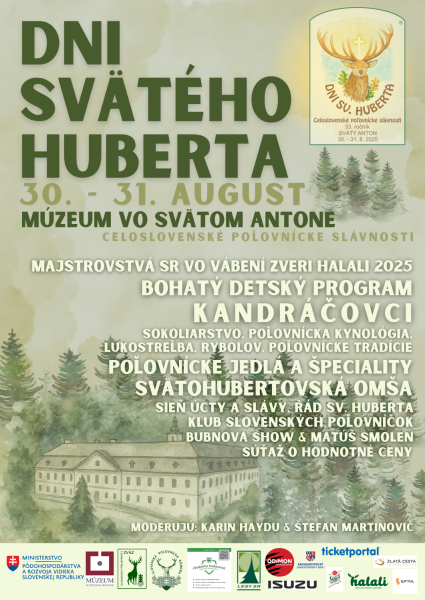

Under the legendary hill of Sitno lies the town of Saint Anton that was built at an important merchandise route, which used to connect Balkan with Cracow and the Baltic area. The town is dominated by the baroque-classicist manor house that was built on a site of a smaller fortified castle mentioned in historical documents as early as in 15th century. It is among those feudal residencies that arose during the intensive construction activity time of the Hungarian military aristocracy who grew rich in anti-Turkish fights and showed great devotion to the Habsburg family. A number of famous European architects and artists participated in building, decorating and later re-building of the manor house (Giulio Ferrari , Jan Entzenhofer, Anton Schmidt and Dionysus Stanetti ).
The manor house was originally built in baroque style as a two-wing building with arcades surrounding an open courtyard with a baroque stone fountain (detail can be seen in the picture of Apotheosis of Death of Mary Gabriella Kohary).
In the middle of 18th century, Earl Andrej Kohary completed the process of re-building the manor house into a wealthy four-wing noble residence.
The Kohary and Coburg families made an essential contribution in the history of the manor house. Here, they concentrated beautiful pieces of artwork and crafts from various parts of the world (18th – 20th centuries). The rich furnishing of rooms reflects the way of life, taste and hobbies of the members of these families.
The manor house has served the purpose of a museum since 1962; currently it is a museum of art, history and hunting.
Owing to the unique integrity, authenticity and variability of collections, the entire complex of the manor house was declared national cultural monument in 1985.
Copyright © 2008 Múzeum vo Svätom Antone; Všetky práva vyhradené. Ochrana osobných údajov Website by g31d creative